
Sınaq göstərişi ölçüsü: 800 × 505 piksel. Digər ölçülər: 320 × 202 piksel | 640 × 404 piksel | 1.024 × 646 piksel | 1.280 × 808 piksel | 2.560 × 1.615 piksel | 7.505 × 4.736 piksel.
Faylın orijinalı (7.505 × 4.736 piksel, fayl həcmi: 4,35 MB, MIME növü: image/jpeg)
 | Bu fayl Vikianbarda yerləşir. Açıqlama səhifəsindəki məlumatlar aşağıda göstərilib. Vikianbar azad lisenziyalı media anbarıdır. Siz də töhfə verə bilərsiniz. |
Xülasə
| İzah |
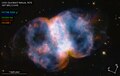
English: In celebration of the 34th anniversary of the launch of the legendary NASA/ESA Hubble Space Telescope, astronomers took a snapshot of the Little Dumbbell Nebula (also known as Messier 76, M76, or NGC 650/651) located 3400 light-years away in the northern circumpolar constellation Perseus. The photogenic nebula is a favourite target of amateur astronomers.M76 is classified as a planetary nebula. This is a misnomer because it is unrelated to planets. But its round shape suggested it was a planet to astronomers who first viewed it through low-power telescopes. In reality, a planetary nebula is an expanding shell of glowing gases that were ejected from a dying red giant star. The star eventually collapses to an ultra-dense, hot white dwarf.M76 is composed of a ring, seen edge-on as the central bar structure, and two lobes on either opening of the ring. Before the star burned out, it ejected the ring of gas and dust. The ring was probably sculpted by the effects of the star that once had a binary companion star. This sloughed-off material created a thick disc of dust and gas along the plane of the companion’s orbit. The hypothetical companion star isn’t seen in the Hubble image, and so it could have been later swallowed by the central star. The disc would be forensic evidence for that stellar cannibalism.The primary star is collapsing to form a white dwarf. It is one of the hottest stellar remnants known at a scorching 120 000 degrees Celsius, 24 times our Sun’s surface temperature.
The sizzling white dwarf can be seen as a pinpoint in the centre of the nebula. A star visible in projection beneath it is not part of the nebula.
Pinched off by the disc, two lobes of hot gas are escaping from the top and bottom of the ‘belt’ along the star’s rotation axis that is perpendicular to the disc. They are being propelled by the hurricane-like outflow of material from the dying star, tearing across space at two million miles per hour. That’s fast enough to travel from Earth to the Moon in a little over seven minutes! This torrential ‘stellar wind’ is ploughing into cooler, slower-moving gas that was ejected at an earlier stage in the star’s life, when it was a red giant. Ferocious ultraviolet radiation from the super-hot star is causing the gases to glow. The red colour is from nitrogen, and blue is from oxygen.
The entire nebula is a flash in the pan by cosmological timekeeping. It will vanish in about 15 000 years.[Image description: Annotated image labeled “Little Dumbbell Nebula, M76, HST WFC3/UVIS” against the black background of space. Near top left, a color key consisting of five lines reads: “F475W SDSS g’” in light blue; “F502N OIII” in dark blue; “F656N Ha” in green; “F658N NIII” in red; and “F814W I” in orange. The nebula is located 3,400 light-years away in the northern circumpolar constellation Perseus. The name ‘Little Dumbbell’ comes from its shape that is a two-lobed structure of colorful, mottled, glowing gases resembling a balloon that’s been pinched around a middle waist. Like an inflating balloon, the lobes are expanding into space from a dying star seen as a white dot in the centre. Blistering ultraviolet radiation from the super-hot star is causing the gases to glow. The red color is from nitrogen, and blue is from oxygen. At bottom left corner is a scale bar labeled “1 light-year.” At bottom right corner, the “E” compass arrow points towards the 10 o’clock position. The “N” arrow points towards the 1 o’clock position.]
|
| Tarix | 23 aprel 2024 (upload date) |
| Mənbə | Little Dumbbell Nebula (M76, annotated) |
| Müəllif | NASA, ESA, STScI, A. Pagan (STScI) |
| Digər versiyalar |
|
Lisenziya
  |
ESA/Hubble images, videos and web texts are released by the ESA under the Creative Commons Attribution 4.0 International license and may on a non-exclusive basis be reproduced without fee provided they are clearly and visibly credited. Detailed conditions are below; see the ESA copyright statement for full information. For images created by NASA or on the hubblesite.org website, or for ESA/Hubble images on the esahubble.org site before 2009, use the {{PD-Hubble}} tag.
Conditions:
Notes:
|
.jpg)
|

_(heic2408b).jpg)
_(heic2408b).jpg)


_(heic2408b).jpg)
Bu fayl Creative Commons Attribution 4.0 Beynəlxalq lisenziyası altında yayımlanır.
Atribut:
ESA/Hubble
- Siz heç bir məhdudiyyət olmadan:
- paylaşa bilərsiniz – əsəri köçürə, paylaya və ötürə bilərsiniz
- remiks edə bilərsiniz – əsəri adaptasiya edə bilərsiniz
- Aşağıdakı şərtlərə əməl etməklə:
- istinad vermək – Müvafiq istinad verməli, lisenziyaya keçid əlavə etməli və dəyişikliklər edilib-edilmədiyini bildirməlisiniz . Siz bunu istənilən şəkildə edə bilərsiniz, lakin lisenziya verənin sizə şəxsən icazə verdiyini göstərən formada yox.
Faylın tarixçəsi
Faylın əvvəlki versiyasını görmək üçün gün/tarix bölməsindəki tarixlərə klikləyin.
| Tarix/Vaxt | Miniatür | Ölçülər | İstifadəçi | Şərh | |
|---|---|---|---|---|---|
| hal-hazırkı | 09:00, 24 aprel 2024 | | 7.505 × 4.736 (4,35 MB) | OptimusPrimeBot | #Spacemedia - Upload of https://cdn.esahubble.org/archives/images/large/heic2408b.jpg via Commons:Spacemedia |
Faylın istifadəsi
Bu faylı istifadə edən səhifə yoxdur (digər layihələrdəki səhifələr göstərilmir).
_(heic2408b).jpg)